 She glided down toward a Monarch who was awake. "Hola!" he said, "Welcome to Mexico! Are you tired?" "Yes, I am tired. Mexico was thousands of miles away!" she replied.
 The two butterflies nestled together on the branches of the oyamel fir tree. They slept all winter long.
After falling in love with a "teeny tiny, creepy crawly bug" from Gotta Go! Gotta Go! (an endearing, uplifting children's book about the journey of a Monarch caterpillar to Mexico by Sam Swope and Sue Riddle) kindergartners began talking about making it into a play. After listening to the story several times, one kindergartner began interviewing classmates and making a list of who wanted to be in the play and what part each friend wanted to be. By the end of cooperative play time that morning, several children were working with him, each making a list of potential actors and actresses for "the egg," "the chrysalis," and "the butterfly."
Over the next few weeks, children took the lead and worked on "The Play" during their free time. The cooperative project took root and blossomed. The character lists for The Play grew as other children joined in and more roles were realized; the book became a useful research tool as children figured out what additional characters they needed to act out the story. They quickly noticed they had forgotten about the role of "the caterpillar" and that there were really two Monarchs in the story, one in the meadow, one in Mexico. One kindergartner went through the book page by page checking to be sure no character had been missed. Aha! Sure enough! The grasshopper, ant, and blue bird had been forgotten. The oversight was quickly adjusted.
The children found they were having a difficult time figuring out what to do about the egg in the story. Would someone actually be the egg? No, that wouldn't work. Caterpillar eggs are very tiny. Would the caterpillar crawl out of a box decorated like an egg? Hmmm...maybe. After much brainstorming, it was decided that the caterpillar egg would be represented by a pretend egg we have in the housekeeping corner. After an agreement had been reached about the egg, thoughts turned to the other characters: what costumes would characters need in their roles as caterpillar, ant, grasshopper, bird, chrysalis, and butterfly?
A prop and costume box was added to the new theater corner (previously the block area) and based on the children's ideas, I added things to it over the next few weeks. One day we designed a wooden stage by piecing together the large wooden blocks; the idea stuck and weeks later grew to incorporate additional blocks that made the stage wider and deeper. We painted colorful murals for the walls in the theater corner and threaded and "crushed" petals for a bouquet of flowers to decorate the stage. Kindergartners invented an area behind the block shelf for actors and actresses to wait for their turns on stage. "Back stage" actors and actresses soon realized they needed help knowing when to take their places on stage; the idea of "stage manager" came naturally into being.
While some kindergartners invented their words based on the story as they remembered it, others requested the help of a "story reader" so "we can know what to do and what to say." I was invited to take the role as The Play's first Narrator/Director and with members of the "audience" that gathered that day, used the text as a guide for stage direction, spoken words, and narration.
Once we had to stop the play and consult the problem-solving directions at the Ice Cream Cone to figure out how our two monarchs would share the part of Monarchs in the play. Using the text, we found out that while one Monarch flies to Mexico in the story, he/she joins millions of other Monarchs in the mountains of Mexico where the second Monarch is featured in the story with a speaking part. Happily, our two monarchs returned to the stage and brought their individual roles to life beautifully! (See blog entry called "One scoop at a time")
On December 6, after several conversations with another kindergartner about how to further develop the theater corner so it would feel like a real stage, two lime-green curtains were installed on a hollow bamboo pole and two rows of chairs for audience members were set up opposite the stage. Every day during Cooperative Play, kindergartners clip their names to the choice area called "The Play."
They role-play. They dream. They become what they dream. They search for language that expresses their dreams. They negotiate and compromise with other dreamers. They take turns. They laugh. They try things one way and re-invent them another way a minute later. They keep trying, even when it's difficult (all dreamers are motivated by their dreams, you see.) They get frustrated by the clash of ideas. They are empowered in capes, goggles, and spray-painted wings. One beloved story, five fabric covered wire flowers, two huge plastic leaves, and one wooden egg you see, is really all it takes to "set the stage" for building community when you're 5 and 6 years old.
A few months ago an adult who heard about this project asked me "So, when's the play?" I smiled and felt my heart flutter with excitement, "I suppose it's today and every day," I replied, "Only the children know for sure."
 In early September, our Kindergarten Salsa Garden beckoned us to explore. The lush green leaves hid ripening tomatoes, peppers and cucumbers. A tower of beautiful "sunrise" honeysuckle bloomed fragrantly nearby. A stepping stone path that began at the gate ended on the far side of the garden where the fragrance of chive, basil, oregano, cilantro, parsley, and mint filled the air. What we found in the Kindergarten Salsa Garden inspired our first Kinder Cooks project. We found a recipe for salsa in our Mexican cook book and got to work!
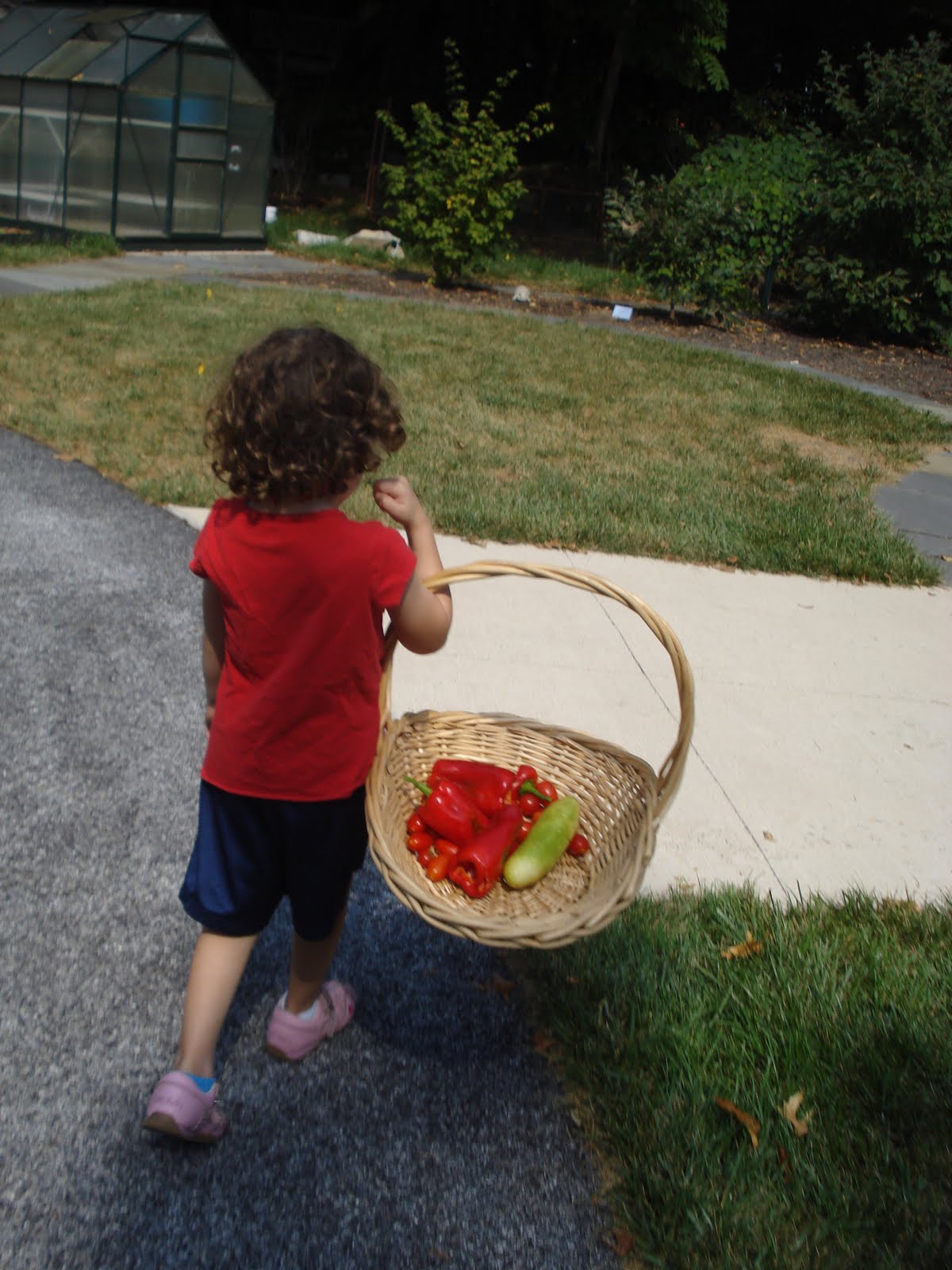 Kindergartners picked the vegetables...
 ...became curious about the seeds found the tomatoes and the peppers...
 ...practiced safe knife handling techniques with plastic table knives and cutting boards using the "one finger pointing" over the top of the table knife and the "helping hand" with a firm tripod grip....
 ...encountered challenges and problem-solved with peers...
 ...experienced how it feels to take turns and be included...
 ...and how delicious snack can be when you make it with friends!


