Friends School Haverford Kindergarten


Saturday, February 5, 2011

Kindergarten's symbolic migration, fall 2010


One day in kindergarten when the sun shone warmly and clouds rolled back to reveal blue skies, we knew it was time to go. With winged headbands bouncing as we walked, we made the journey by foot to the Haverford College climbing tree, bare-branched Osage orange tree that has for decades been a favorite destination for children at FSH. This particular tree, unlike others in the area, beckons children to test their climbing skills like no other. with root-like branches twisting and turning within reach, children take to it with great enthusiasm. See more photos from our day in the slideshow sidebar!

On this particular day, the tree was our Mexico. Children alighted on the branches with smiles, draping their bodies over the branches and trunks, sighing with delight. When they had rested, they climbed about, stretching the limits of their physical bodies while sharing strategies and cheering one another on. Our monarchs found nectar and water too in this their symbolic Mexican winter home. We shared a morning snack of fresh fruit salad, water, and juice boxes (which we enjoyed with our proboscises, our straw-like tongues).

Kindergarten joined the symbolic monarch migration this fall, a project sponsored by Journey North, A Global Study of Wildlife Migration and Seasonal Change. We made paper butterflies and attached notes pf friendship to students who live in the butterfly sanctuaries in central Mexico. Our paper butterflies and letters traveled thousands of miles to their winter home along with the live butterflies that we had tagged in our classroom this fall. We will be using this site this spring to follow the northward journey of the monarchs to our schoolyard garden.


Wednesday, February 2, 2011

Looking Back...our tagged Monarchs take flight!

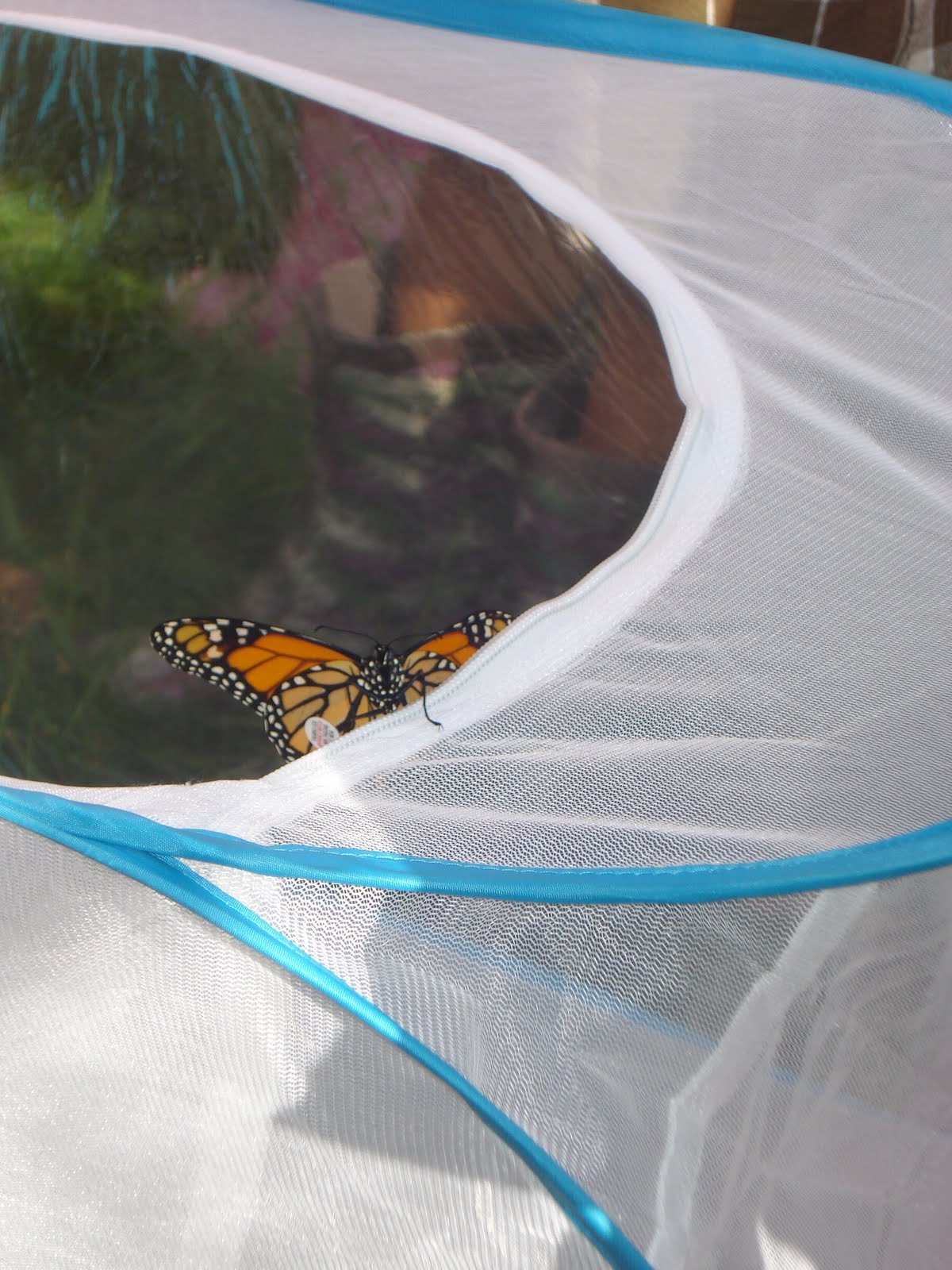
With tracking tags purchased from Monarch Watch, a program developed by the University of Kansas, the kindergartners tagged their butterflies before releasing them outdoors. Together we learned how to adhere the tags (tiny, numbered stickers) to the hindwings of the butterflies and recorded information about each butterfly (sex, origin, location) on our data sheet.

With reports from individuals who find the tagged butterflies along the migration route researchers gain insight about the southward migration of Monarchs through the mid-west, along the Eastern coast of United States, across the Gulf states, and over the border on their journey to the oyamel forests in the mountainous region of Central Mexico.


On our campus we have a special wildlife habitat garden that has been certified as a Monarch Waystation with Monarch Watch. Affectionately it is known on campus as The Puddle as not only does this wild space provide nectar and host plants for Monarch butterflies, it features a small pond with solar-powered fountain and serves as a rain garden during times of heavy rain and snowfall. We release our monarchs in this beautiful area every fall.


Saturday, January 29, 2011

Looking Back...the cats, the chrysalides, and the winged wonders!


Tiny insects, some in striped pajamas and suction cup slippers and others in scaled wings and delicate spiraled tongues welcomed the kindergartners to Friends School Haverford this past fall. Still others, in the the mysterious universes of their lime green sleeping bags, hung quietly from tiny silk buttons where moments before, a caterpillar had split it's skin for one last time, and waited quietly for the warm morning sun when a child happened by and noticed something special happening.

Kindergarten fell in love with the monarchs, just as they always do. I was once again, right there with them.

The story in photos continues..


Wednesday, January 5, 2011

Playground Math: How many ways can we make 10?

"Math is indeed all around us!" I whispered to the children as they children lined up after outdoor play recently. I looked left, I looked right, I looked directly at the children and counted slowly to 10. Ten pairs of eyes were glued on mine. Though we had been practicing many different ways of counting to 10 when we lined up to move as a class from place to place (by ones, by twos, by threes with one group of four, by two groups of five, 1 to 10, 10 to 1, and the famous "Buzz" count) this was the "just right" moment to take it a bit further. I extended an invitation to the children to come to Meeting for Learning (Math Workshop) to learn more about my Very Mysterious and Most Curious Observation.

After the children gathered on the carpet, I began described what I had observed happening on the playground.

When I call kindergarten to line up at the end of outdoor play, I explained, some children arrive at the meeting place ahead of others. All children do not get in line at exactly the same time. I've been noticing how some children get in line right away if they are close by when they hear me calling. Others playing in places on the playground that are further away need more time to walk or run over to the kindergarten line. Every day the numbers of children in line are different than the numbers of children who are not yet in line. On a day that all kindergartners are present at school, I explained, the numbers always add up to 10 no matter how many students are "in line" and how many are "on the playground."

I acted out the playground "lining up"scenario using unifix cubes. I used a few unifix cubes to represent "kindergartners in line" and others to represent "kindergartners on the playground." I made the groups visible and distinct on the carpet in front of me. "Today," I explained, "Three children were in line ahead of all the others. While they were in line, I counted 7 children who were on the playground." I explained how I noticed that the 3 children in line and the 7 children still on the playground made 10 children "all together." I demonstrated using unifix cubes how the 3 and the 7 equals 10.

I asked the children a few questions about my playground scenario to check for understanding. We reversed the numbers ("Hmmm. I wonder what it would have looked like if 7 had been in line and 3 were on the playground? Can you help me figure that out?") and checked and re-checked our counting: sure enough, our answers equaled 10 every time (3 and 7, and 7 and 3).

I said that I wondered if we could find more "playground stories" that make 10. It seemed to be a very mysterious and most curious question. The children were very eager to try a few playground stories of their own.

I asked the kindergartners to each take 10 unifix cubes to a quiet place somewhere in the room to work on storytelling. They practiced telling number stories using the framework set forth in our previous storytelling. The room buzzed with audible storytelling. I observed many unifix representations of "kindergartners in line" and "kindergartners on the playground." Some children were adding in dialouge, props, and description of specific playground activities.


After 15 minutes of observation and one-on-one conferencing with children as they worked independently, we met back on the carpet to share and record our number stories.

The following represents the number stories related by the children:

Kindergartners in line:

Kindergartners on playground:

7

3

6

4

8

2

3

7

4

6

2

8

0

10


We acted out the number stories as we recorded them on the chart. After we made the chart, we noticed that switching the pairs of numbers "made 10" every time. We wondered if there are more "ways to make 10" than the ones we recorded today. "Oh, yeah, and what about that day when someone was absent?" a kindergartner remarked as we moved to lunch. "Then we wouldn't have 10. We would have 9. That would be one less than 10, " he said with a smile.

To be continued...

Gumdrop Construction and Number Stories


On the first day of our Meeting for Learning (Math Workshop) activity this week we used gumdrops and toothpicks as building materials. Our challenge was to construct a shape horizontally and then continue building vertically beginning with 10 gumdrops.


Many kindergartners practiced making three-gumdrop triangles and four-gumdrop squares. Some children found ways of attaching different shapes to each other. In some cases building vertically was not intuitive and it took problem-solving with a friend to figure it out.


On the second day, we recorded the number of each color gumdrop in our gumdrop constructions and sketched our pieces. We noticed that wherever there were triangles, there were 3 gumdrops and three toothpicks. We noticed that wherever there were squares, there were 4 gumdrops and 4 toothpicks.


(More photos from our activity are in the "Kindergarten Favorites" slide show.)